
William Smithson
Unfortunately, no photos of Deputy William Smithson—who was shot and killed in 1907—have been found. With the help of Ancestry and various other resources, we set out in search of a photo to honor our fallen brother.
Deputy Sheriff William Smithson was shot and killed as he attempted to arrest a man following a dispute at a the American Borax Company Plant in Daggett. The man had struck the plant foreman over a pay dispute.
The foreman informed Deputy Smithson of the assault and the two, along with Deputy Smithson's assistant, went to look for the suspect. They located him on a street and as Deputy Smithson began to ask how he was doing, the man suddenly produced a revolver and shot him five times in the upper body.
Deputy Smithson was taken to the local billiard hall where he succumbed to his wounds the following morning.
The suspect was arrested during a search by a large posse. He was convicted of Deputy Smithson's murder and sentenced to death. The governor later commuted his sentence to life. He died in San Quentin State Prison in 1912.
Deputy Smithson had served with the San Bernardino County Sheriff's Office for approximately two years. He was survived by his wife and daughter.
ARTICLE FROM THE 2007 SHERIFF’S ANNUAL REPORT REGARDING WILLIAM SMITHSON
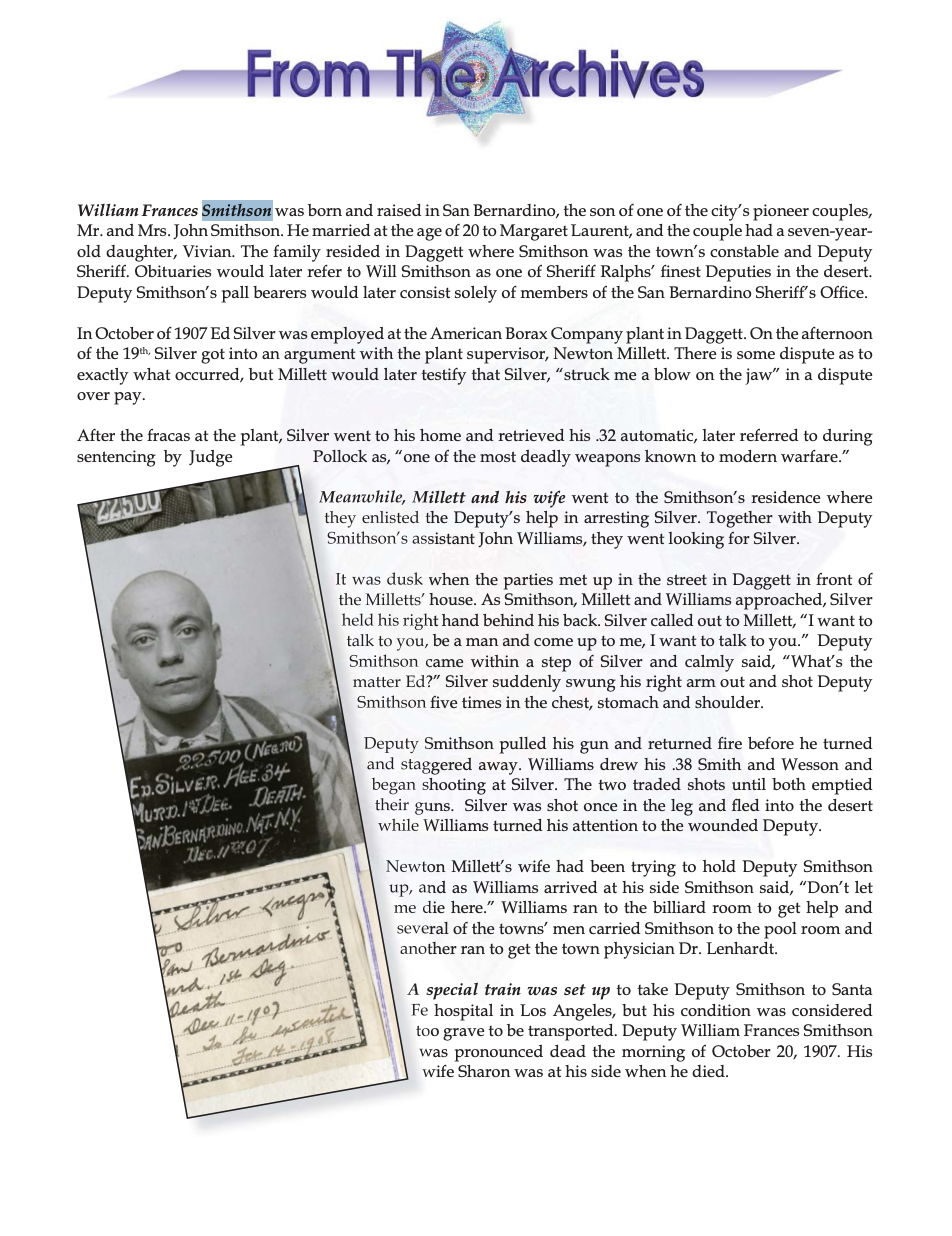
William Frances Smithson was born and raised in San Bernardino, the son of one of the city’s pioneer couples, Mr. and Mrs. John Smithson. He married at the age of 20 to Margaret Laurent, and the couple had a seven-yearold daughter, Vivian. The family resided in Daggett where Smithson was the town’s constable and Deputy Sheriff. Obituaries would later refer to Will Smithson as one of Sheriff Ralphs’ fi nest Deputies in the desert.
Deputy Smithson’s pall bearers would later consist solely of members of the San Bernardino Sheriff’s Offi ce. In October of 1907 Ed Silver was employed at the American Borax Company plant in Daggett. On the afternoon of the 19th, Silver got into an argument with the plant supervisor, Newton Millett. There is some dispute as to exactly what occurred, but Millett would later testify that Silver, “struck me a blow on the jaw” in a dispute over pay. After the fracas at the plant, Silver went to his home and retrieved his .32 automatic, later referred to during sentencing by Judge Pollock as, “one of the most deadly weapons known to modern warfare.”
Meanwhile, Millett and his wife went to the Smithson’s residence where they enlisted the Deputy’s help in arresting Silver. Together with Deputy Smithson’s assistant John Williams, they went looking for Silver. It was dusk when the parties met up in the street in Daggett in front of the Milletts’ house. As Smithson, Millett and Williams approached, Silver held his right hand behind his back. Silver called out to Millett, “I want to talk to you, be a man and come up to me, I want to talk to you.” Deputy Smithson came within a step of Silver and calmly said, “What’s the matter Ed?” Silver suddenly swung his right arm out and shot Deputy Smithson fi ve times in the chest, stomach and shoulder.
Deputy Smithson pulled his gun and returned fi re before he turned and staggered away. Williams drew his .38 Smith and Wesson and began shooting at Silver. The two traded shots until both emptied their guns. Silver was shot once in the leg and fl ed into the desert while Williams turned his attention to the wounded Deputy. Newton Millett’s wife had been trying to hold Deputy Smithson up, and as Williams arrived at his side Smithson said, “Don’t let me die here.” Williams ran to the billiard room to get help and several of the towns’ men carried Smithson to the pool room and another ran to get the town physician Dr. Lenhardt.
A special train was set up to take Deputy Smithson to Santa Fe hospital in Los Angeles, but his condition was considered too grave to be transported. Deputy William Frances Smithson was pronounced dead the morning of October 20, 1907. His wife Sharon was at his side when he died. Following the shooting, Sheriff Ralphs was telephoned in Imperial where he had traveled on Department business. He headed for Barstow and swore in a posse of 12 men.
Undersheriff McNabb formed a posse in San Bernardino which included Deputy Smithson’s brother J.B. A third posse was formed by San Bernardino Police Chief Seccombe. On October 21st at around 11:00 pm, Undersheriff McNabb and his men hiked up the Cajon Pass about two miles above Devore. They “set up” on both sides of the wagon road and waited for Silver.
They had waited about an hour when Silver came walking down the road. Deputy Sheriff Hardy shouted, “Halt, we’re offi cers, throw up your hands.” Silver initially hesitated, but quickly surrendered. Hardy searched Silver, and took the Colt .32 automatic. Silver had a gunshot wound to his left leg above the knee.
The San Bernardino Daily Sun would later credit neither Smithson nor Williams for the wound, but “a hunchback who joined in the fusillade at Silver after he shot Smithson.” Silver was driven to Glen Helen, then on to San Bernardino and the county jail. Reports of a possible lynching reached Sheriff Ralphs and the decision was made to transfer Silver.
At about 1:30 pm on the 22nd a large red automobile stopped in front of the jail and Ed Silver and Deputy Sheriff Carter took seats in the back. The car sped off to Riverside where Silver was housed before being sent by train to Los Angeles. On October 23rd a warrant was issued for murder and signed by Judge J.R. Pollock of the Justice Court of Ontario. Silver was ordered held without bail. Silver was held in Los Angeles for 10 days and then transferred to Ontario for the preliminary hearing in Judge Pollock’s court.
On December 4th Ed Silver plead guilty in front of Judge Benjamin F. Bledsoe for the murder of Deputy Sheriff William Smithson. A hearing was later held on December 7th to determine the degree of murder and a subsequent punishment. Newton Millet, John Williams, Doctor Lenhradt and Ed Silver himself testifi ed during the hearing, the latter claiming he shot the Deputy out of fear he would be shot himself.
The self-defense theory was rejected by Judge Bledsoe who cited that Silver had no right to assume Smithson would do him harm as, “persons starting out on an expedition to shoot or wrong or injure another, hardly ever take a woman along with them.” Judge Bledsoe ordered Ed Silver delivered to the San Quentin prison where he be hanged by the neck until dead. After several appeals, which were denied by the state supreme court, Governor J. N. Gillett commuted Silver’s death sentence to life in prison.
Edward Silver died in San Quentin prison on May 6, 1912 of acute peritonitis. He was 38 years old. Deputy
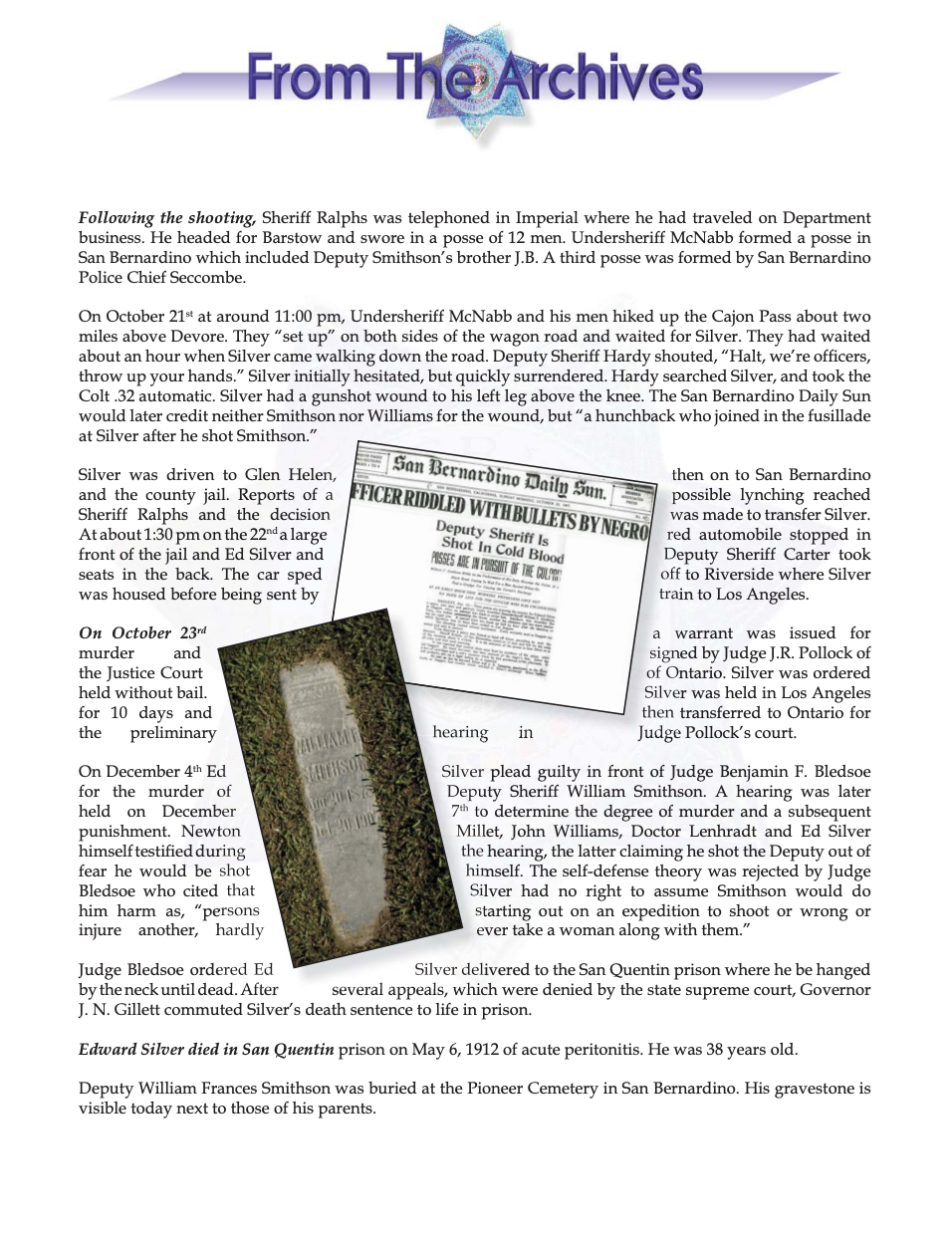
William Frances Smithson was buried at the Pioneer Cemetery in San Bernardino. His gravestone is visible today next to those of his parents.
Shortly after the countywide peace officer memorial in May 2023, SEBA joined members of the Sheriff's Honor Guard as they embarked on a mission across the county. Their goal? To draw attention to specific monuments dedicated to their fallen brothers.